
Chest
Freezer Repair
A low, wide box with a lid that lifts from the top, cooled by coils wrapped inside its walls, the long-term freezer of basements, garages and utility rooms.
Mon–Sat, 8am–8pm
- 4 things that fail on it
- 4 makes build it
- 6 problems it shows
Book a visit
Three short steps, about a minute.
or call (844) 456-4651
Loading appointment form…
The appointment form couldn’t load. Please try again.
Is yours
a chest?
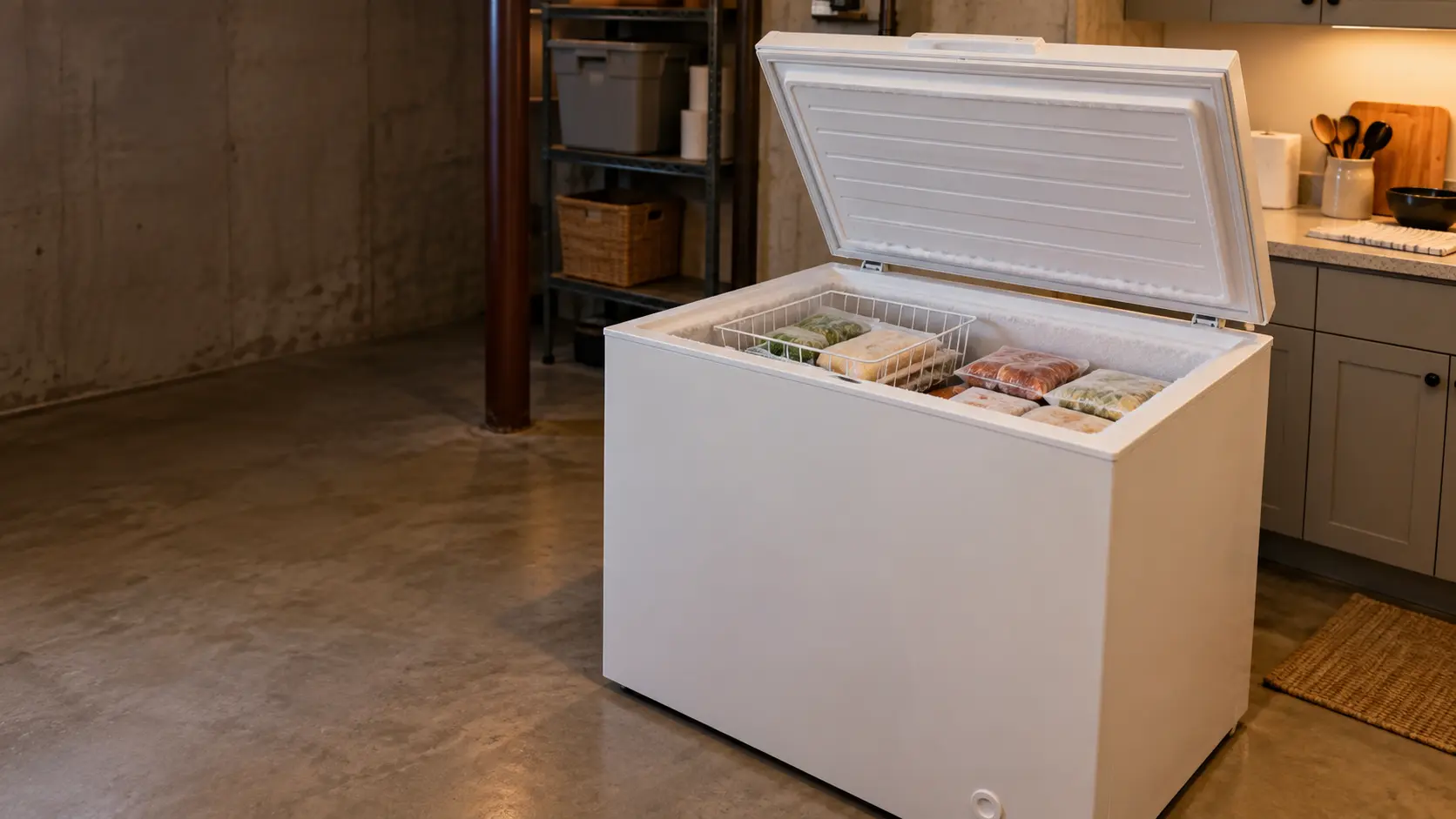
A chest freezer is the simplest freezer made, and that is why it lasts. The cold comes from tubing wrapped around the inner liner, hidden in the foam between the liner and the outer skin, so there is no fan inside and no panel to hide a coil. Cold air is heavier than warm air, so when the lid lifts very little of it escapes, which is why a chest holds food longer through an outage than an upright of the same size. The trade is manual defrost: frost forms on the walls every time the lid opens, and it has to be melted off by hand once it is a quarter inch or so thick. The condenser is usually built into the outer walls too, so the sides feel warm while it runs. When a chest freezer stops keeping food frozen, the reason is most often the lid seal, the thermostat, the start relay, or a room colder or hotter than it was built for, and less often a leak in tubing no one can see.
 What fails on a chest freezer
How to tell
The freezer is a rectangular box about waist high, and the lid lifts upward on hinges at the back instead of swinging open like a door.
Inside there is one deep well with a hanging wire basket or two, and the walls are smooth, with no vents, fans or shelves.
The outside walls feel warm to the hand when the compressor is running, because the heat is shed through tubing inside the cabinet skin.
A drain plug sits low on the front or side, and the temperature dial and a power light are usually on the front corner or just under the lid.
What fails
on this design.
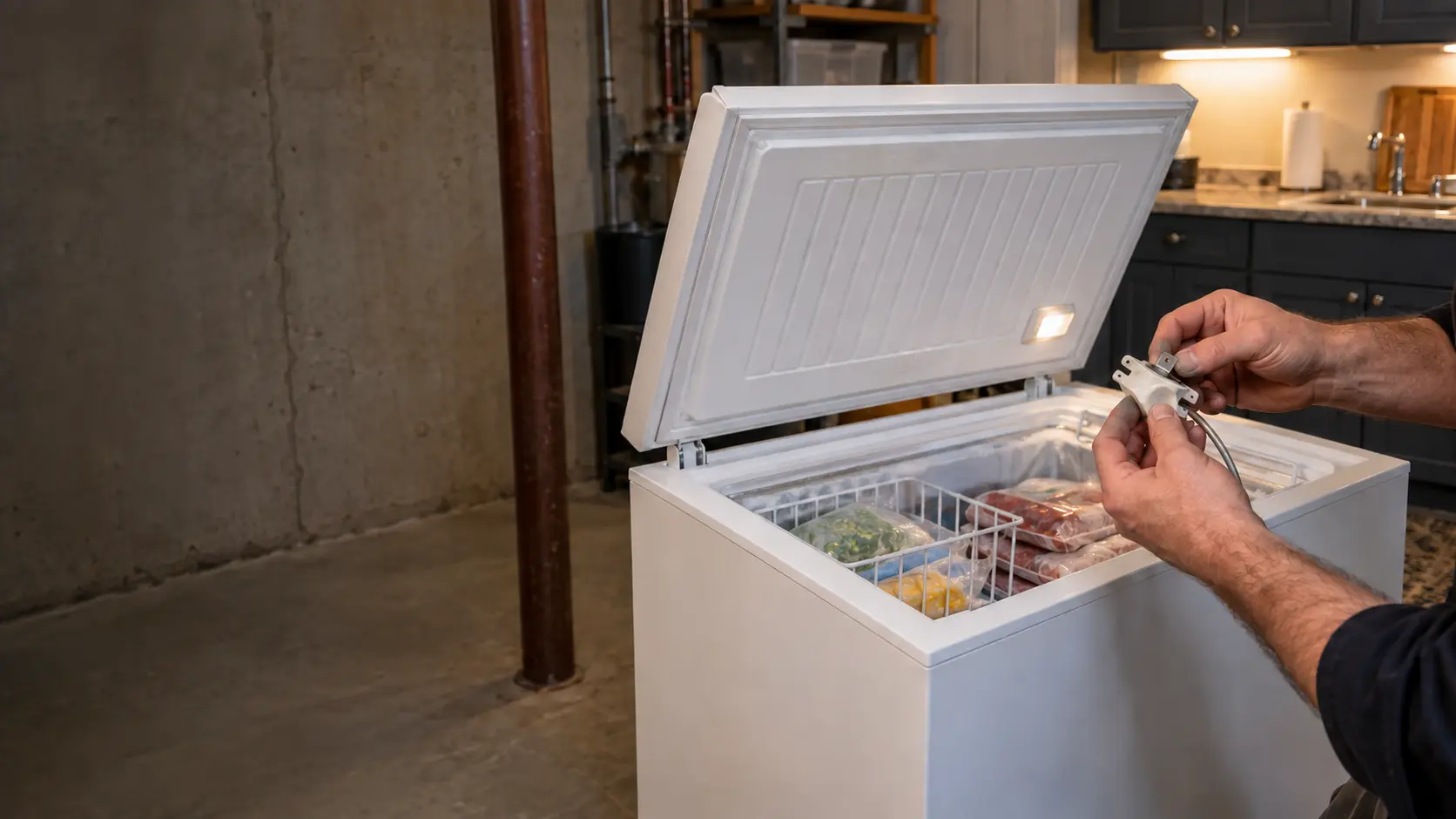
On a chest freezer: a lid that no longer seals, the thermostat or temperature control, the relay that starts the compressor, a slow leak in the tubing.
The problems it showsA lid that no longer seals
A gasket that has torn, flattened or pulled away from the lid, or hinges that have weakened with age, lets moist air in all day. The frost on the walls grows much faster than usual, especially along the top edge, and the compressor rarely rests.
The thermostat or temperature control
A worn thermostat can leave the freezer running without end and freezing everything rock hard, or stop calling for cold so the food slowly softens. A control that is just set too warm after a cleaning is a common and easy find.
The relay that starts the compressor
When the start relay or overload fails, the compressor tries, clicks off, and tries again a few minutes later. The cabinet stays silent in between, the walls never get warm, and the food begins to thaw while the power light stays on.
A slow leak in the tubing
Because the evaporator and often the condenser are foamed into the walls, a pinhole leak in either one shows up as a freezer that runs all day but only partly freezes. A sealed-system repair on a chest freezer is possible but costly, and the technician compares it to a new cabinet.
Getting at it,
and whether to.
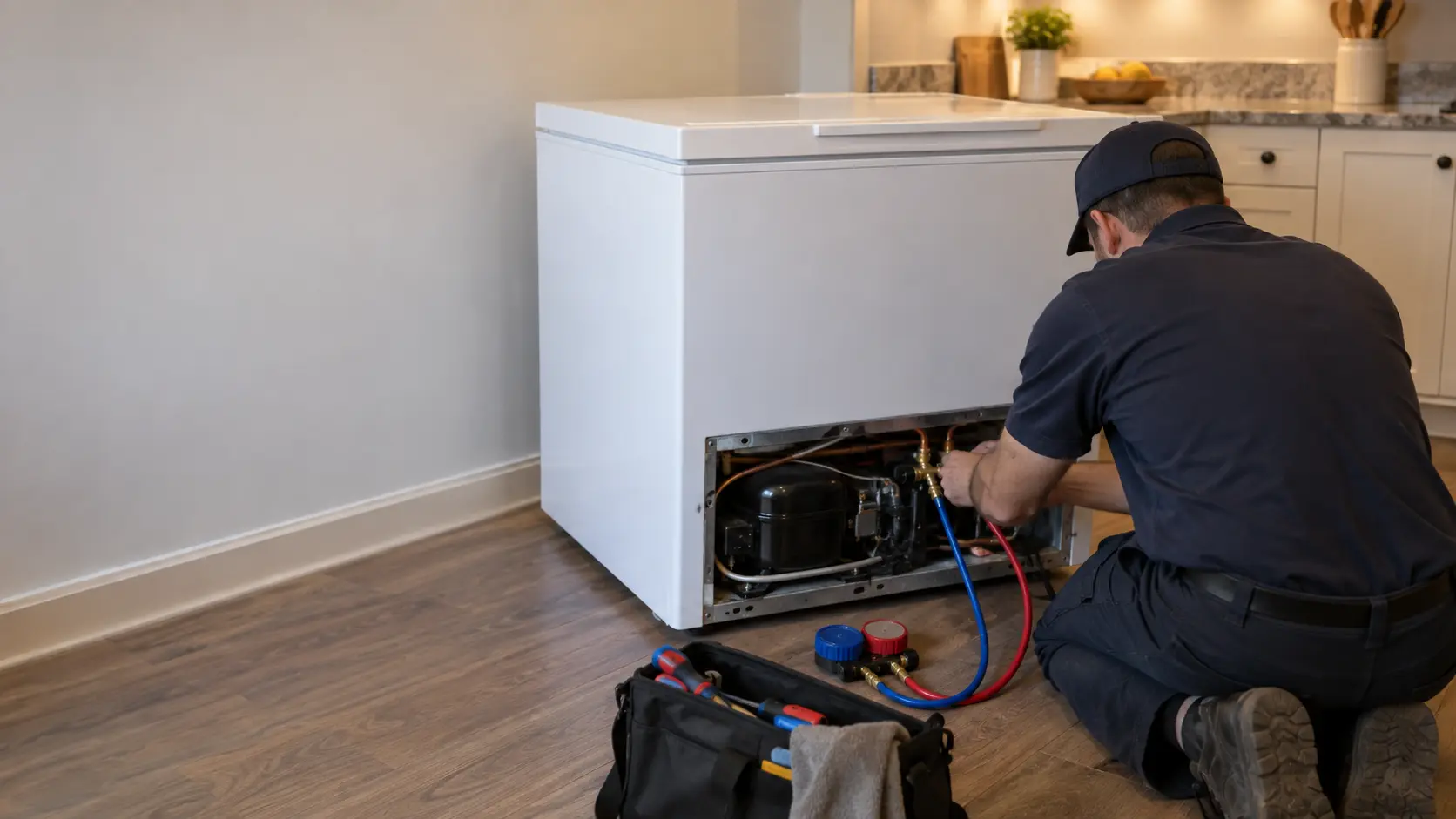
The compressor, relay and thermostat wiring are behind a small grille at the lower back or side, so the freezer needs to come out from the wall far enough for a person to kneel behind it.
What repairs costOn the visit
- A chest full of food is heavy and awkward to move; if it sits in a tight corner, emptying it into coolers before the visit lets it be pulled forward safely.
- The drain plug and the lid gasket are checked from the front, and a hose or pan helps catch meltwater when frost has to come off first.
- Tell us if the freezer sits in an unheated garage, a hot attic space or on an outdoor porch, since the room temperature is part of the diagnosis.
Repair or replace
A chest freezer has few parts, so the common repairs are among the most affordable in the whole appliance: a lid gasket, a thermostat, a relay or an overload. Those are nearly always worth doing on a freezer that is otherwise sound. The harder call is a leak in tubing foamed into the walls, because reaching it can mean cutting into the cabinet, and on a small or older chest that cost can pass the price of a new one. The technician will tell you plainly which side of that line your freezer is on.
Book a visit for a chest freezerThe problems
it shows.
On a chest freezer, most often chest freezer ice on the walls.
All problems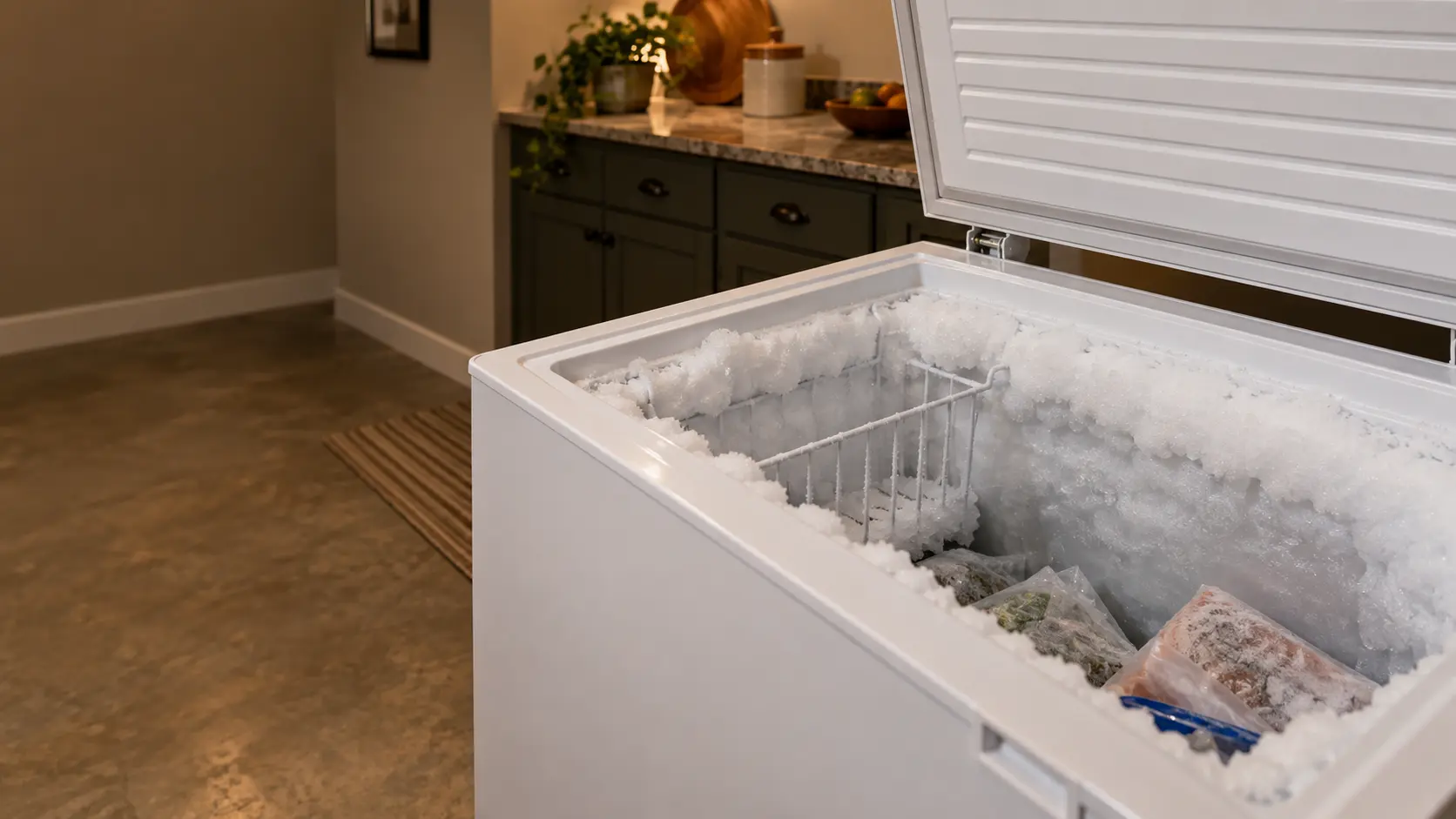
Chest Freezer Ice on the Walls
5 causes, cheapest first
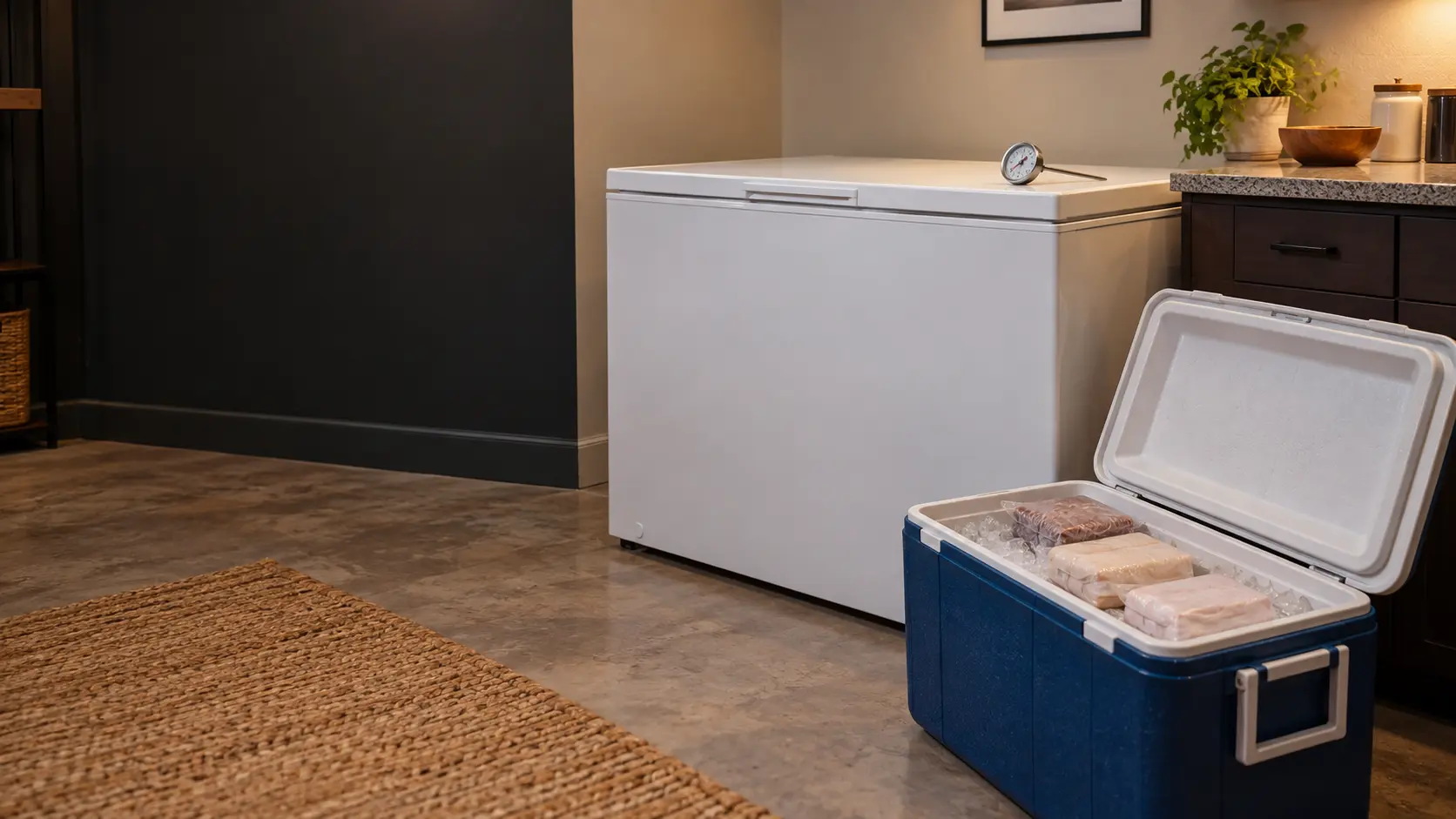
Freezer Warming Up With Food Inside
5 causes, cheapest first
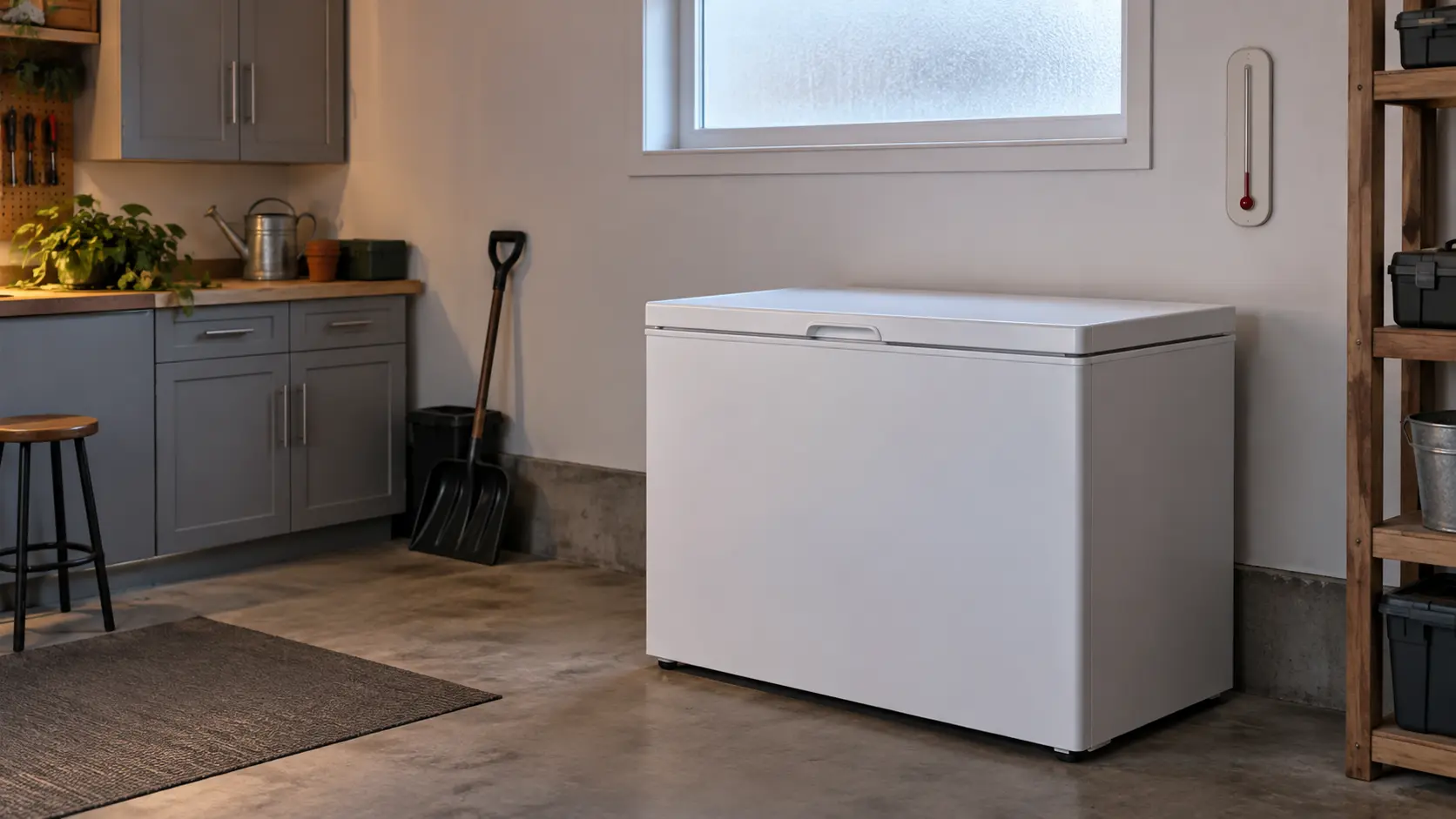
Freezer in the Garage Stopped Working
6 causes, cheapest first
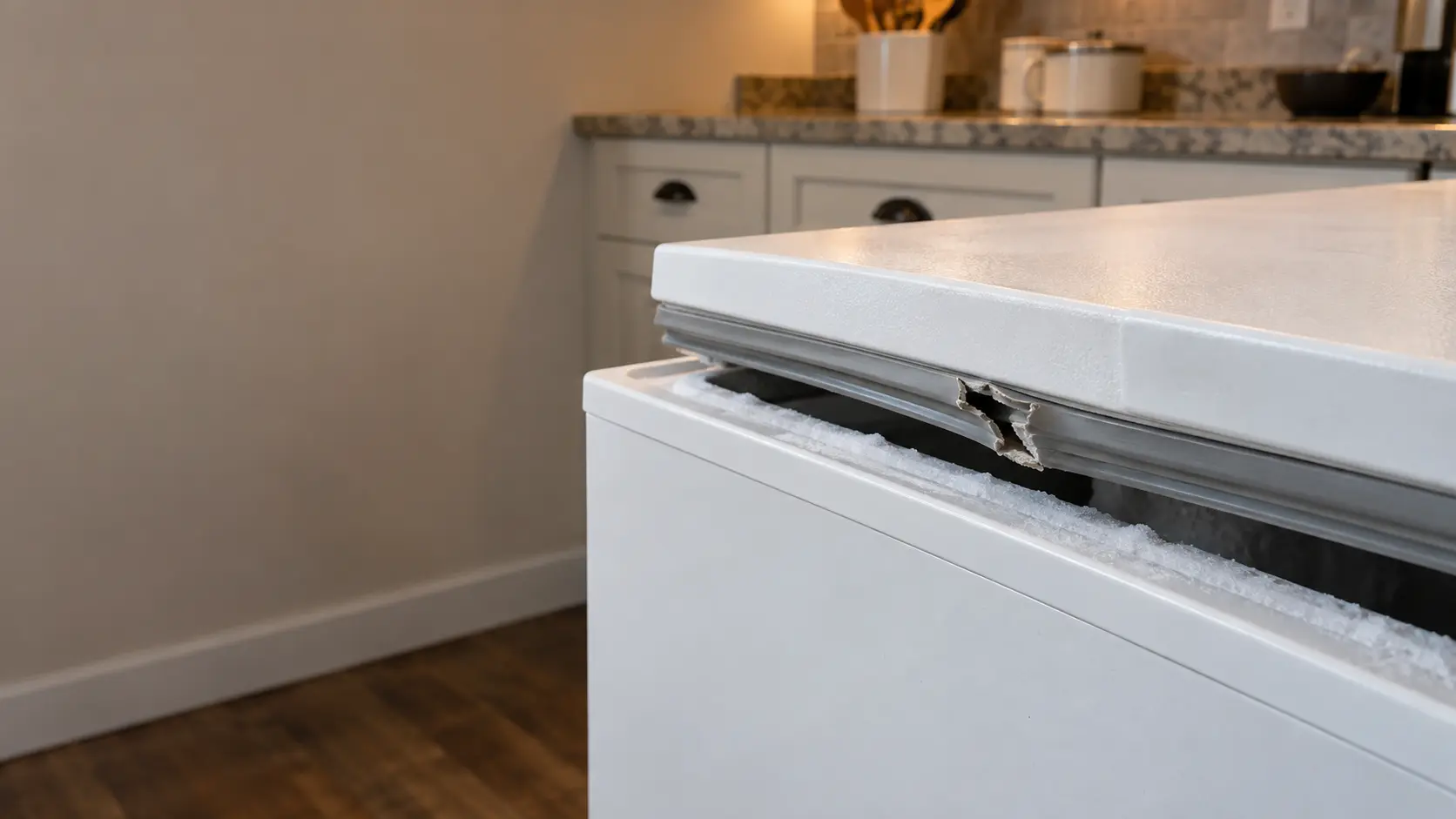
Freezer Door or Lid Not Sealing
5 causes, cheapest first
Freezer Won't Turn On
5 causes, cheapest first
Freezer Keeps Tripping the Breaker
5 causes, cheapest first
Who builds
a chest.
4 of the makes on this site build a chest freezer. Each mark opens that make's own page.
All 28 brandsChest freezer repair,
where we come out.
9 metros, each with its own page.
All service areasTampa BayFL · 31 areas
Miami / South FloridaFL · 47 areas
New York MetroNY · 75 areas
HoustonTX · 36 areas
ChicagoIL · 50 areas
Los AngelesCA · 95 areas
San DiegoCA · 31 areas

Questions about
chest freezers.
How thick can the frost in a chest freezer get before it needs defrosting?
What is the right way to defrost a chest freezer without harming it?
Why are the outside walls of my chest freezer warm?
Does a chest freezer need space around it?
Back to your everyday
Is it a chest freezer?
Say so when you book — it changes what the technician brings and how the visit is planned.