Why packing matters to the machine
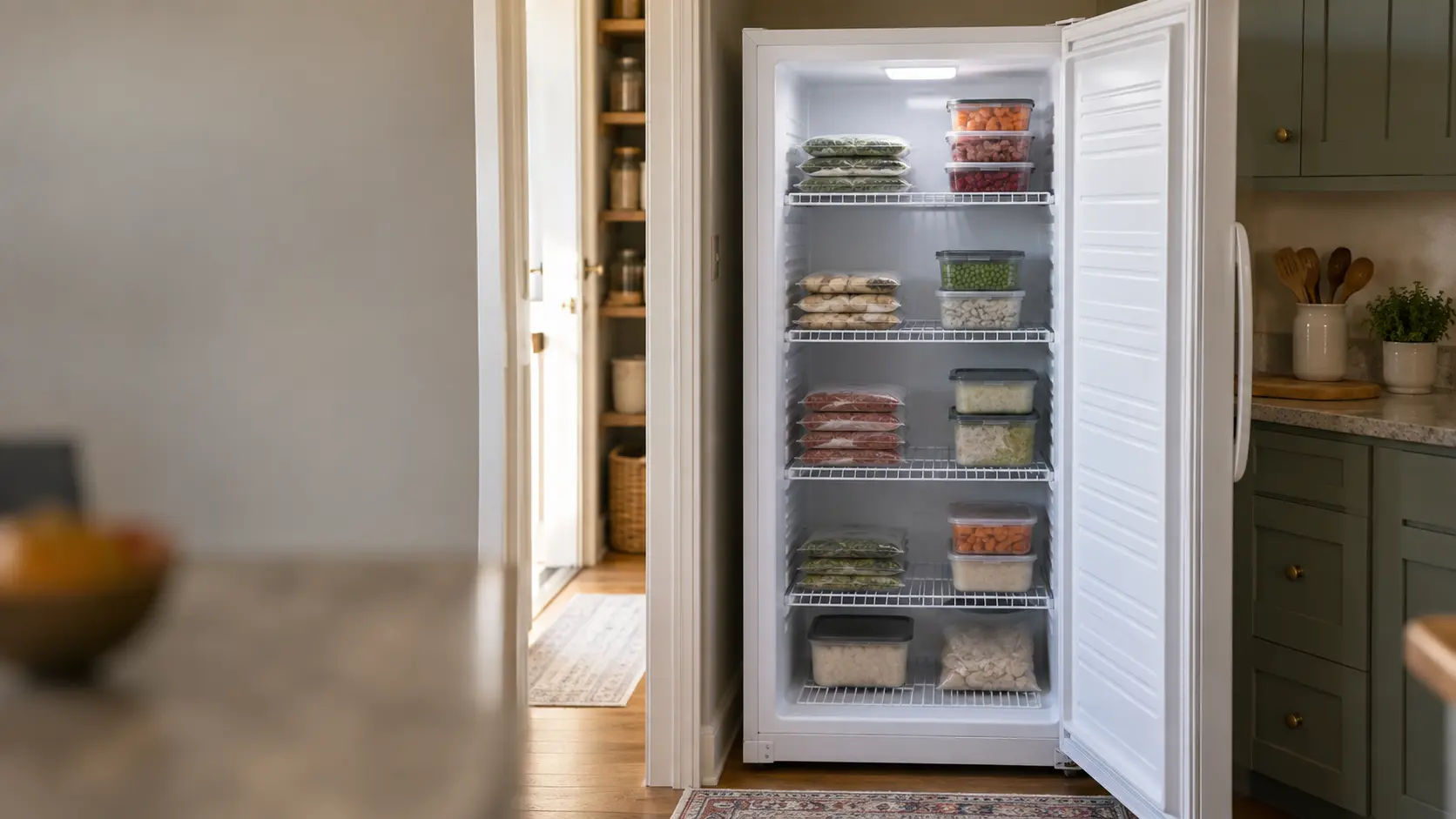
FDA's storage advice is short on this point: do not crowd the freezer so tightly that air cannot circulate. A packed wall of boxes slows how quickly new food freezes, hides warm spots and makes it harder for the thermostat to read what the food is really doing. Where the cold comes from decides where the space must stay open.
Learning how to organize a freezer starts with knowing which of the three layouts below you have. GE's description of chest and upright designs is the map.
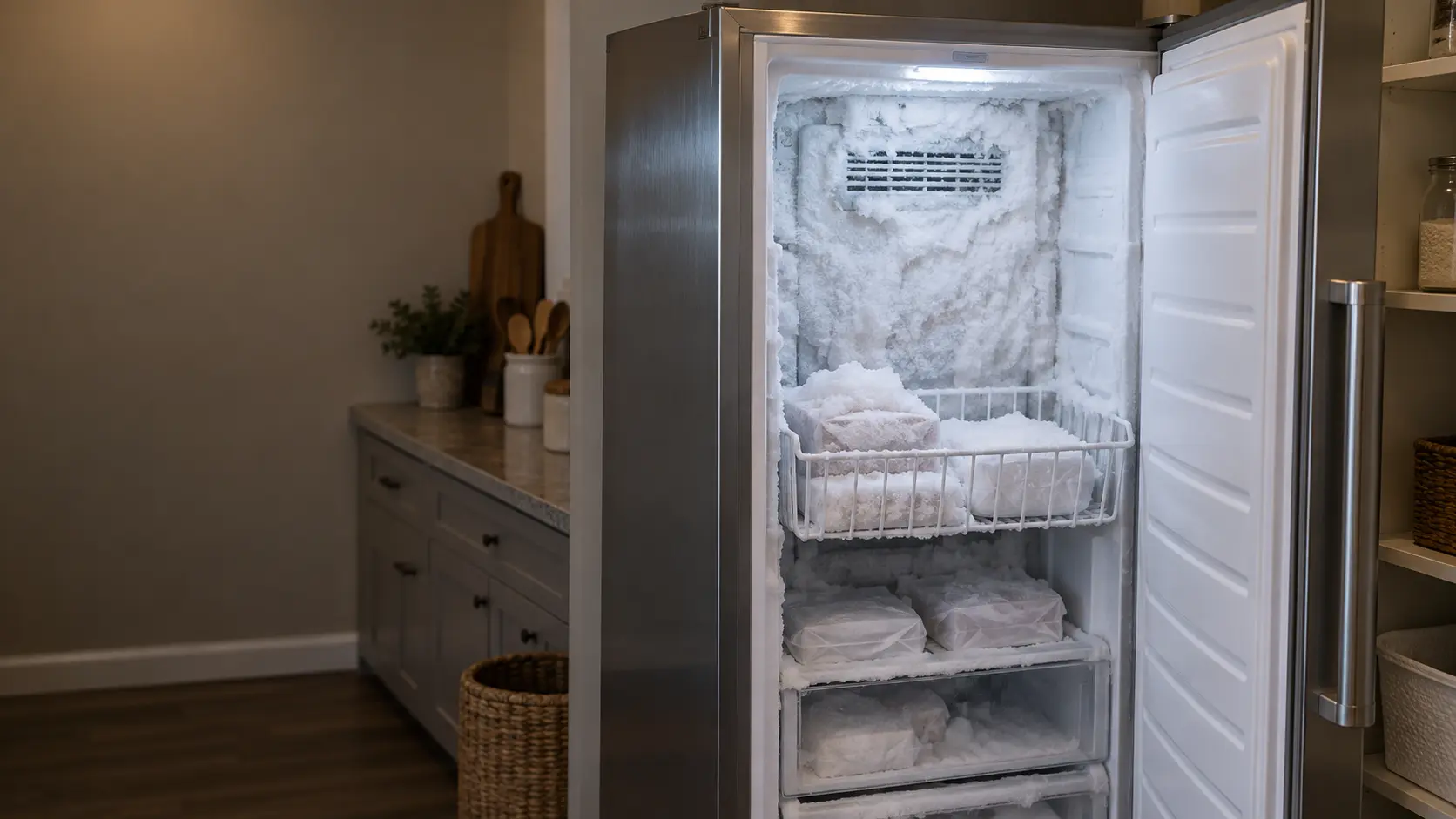
Frost-free uprights
The evaporator sits low at the back and a fan blows cold air up through openings in the rear wall. Keep a finger's width of space in front of those openings and between packages and the back panel, or the top shelves run warmer than the bottom.
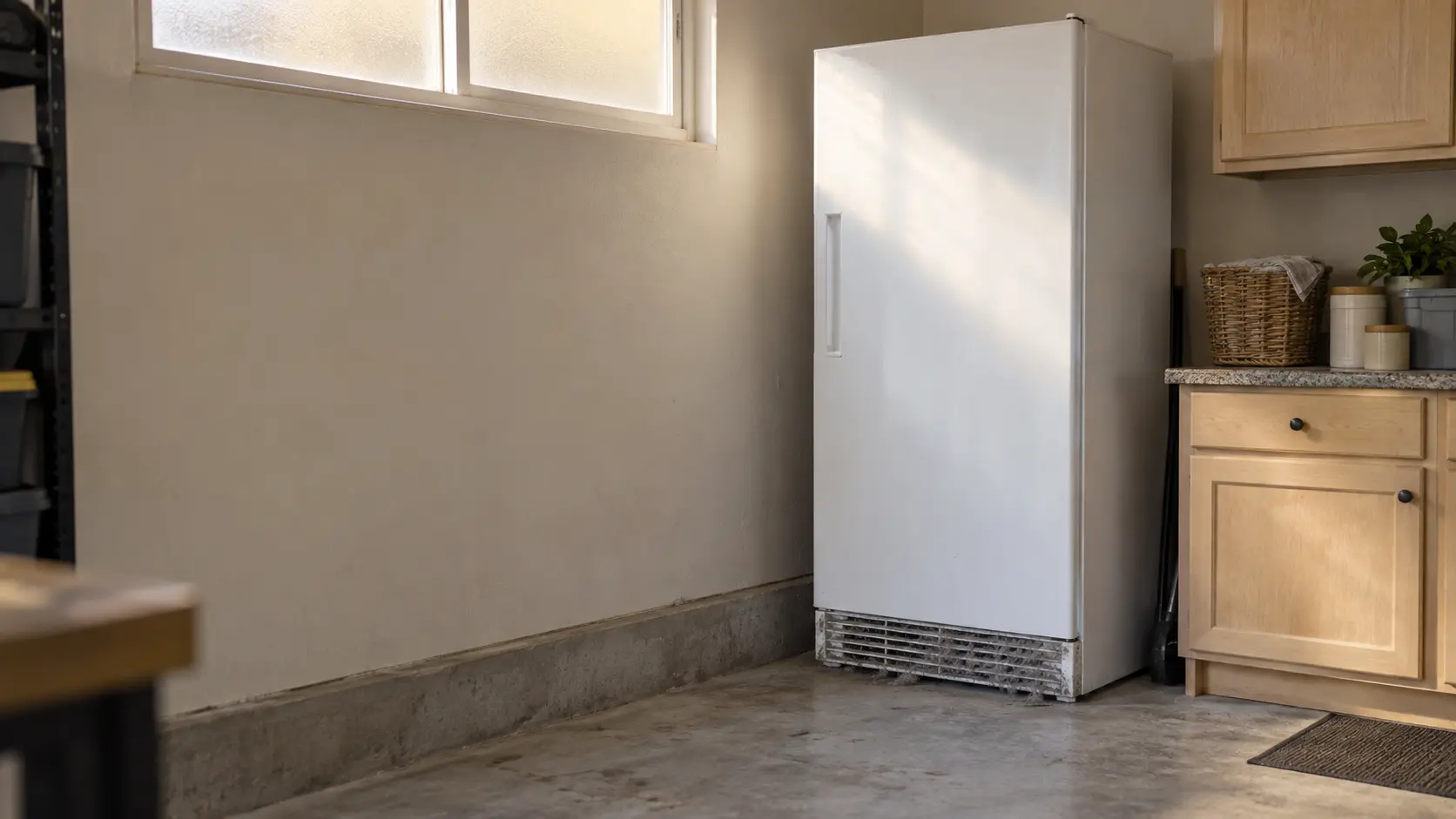
Manual defrost uprights
Here the shelves themselves are the cooling coils. Food freezes fastest in direct contact with a shelf, so new packages belong flat on the coils, not stacked on older ones or parked in a door bin.
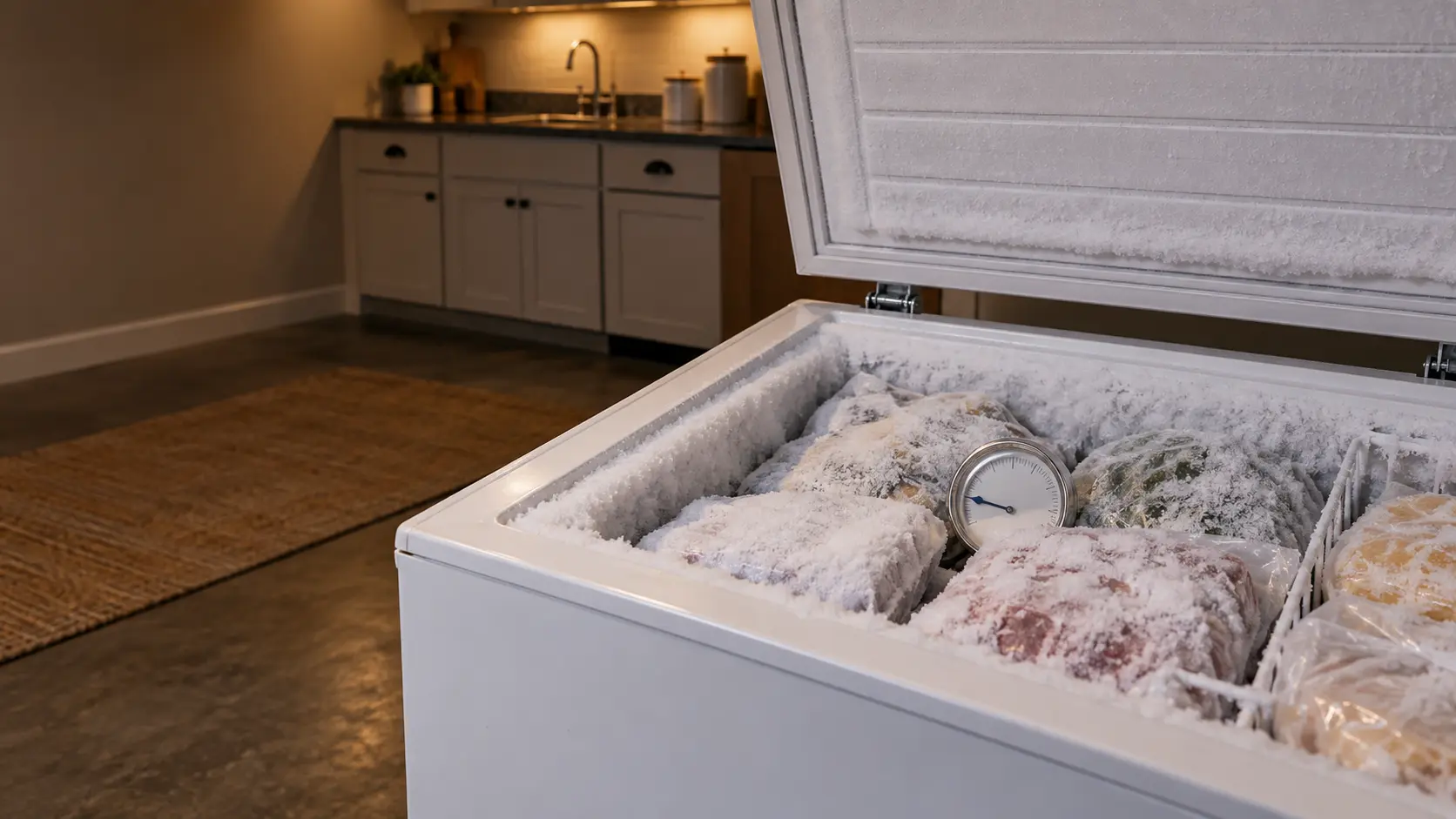
Chests
A chest cools through its walls. The food against the walls is coldest and freezes fastest; the middle of a deep pile is the slowest. Hanging baskets across the top keep small items reachable without breaking up that layout.
Source: FDA — Are you storing food safely? — Do not crowd the freezer so tightly that air cannot circulate; keep it at 0°F; keep an appliance thermometer at the front and check it weekly; freezer burn is a quality issue; GE Appliances — Upright and chest freezer: wrap-around condenser and evaporator — Chest evaporators are inside the walls; manual defrost upright shelves are the evaporator; frost-free uprights have the evaporator at the lower back
Loading new food so it freezes fast
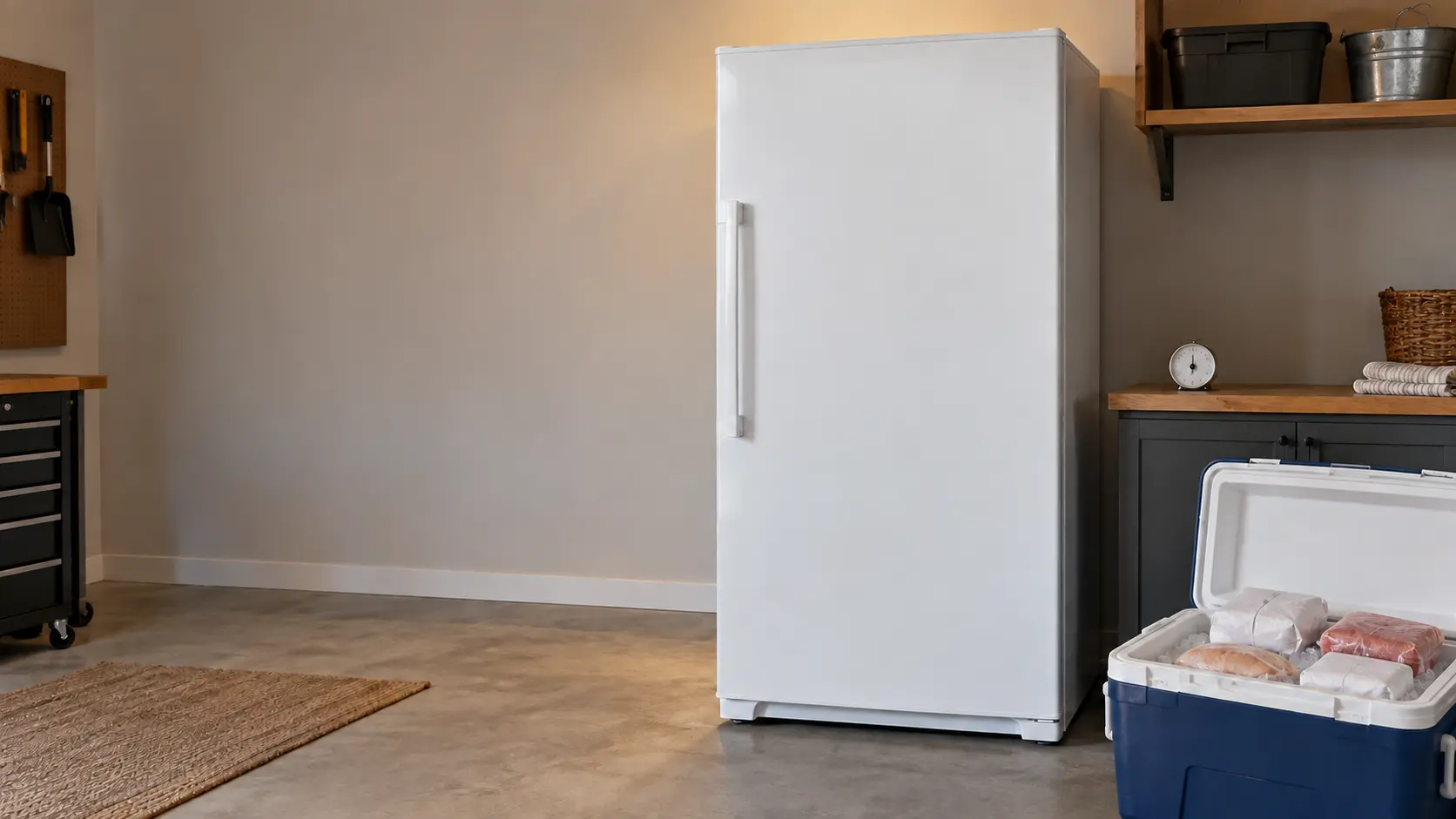
FSIS says food should freeze as quickly as possible, because slow freezing grows large ice crystals that tear cells and leave meat dripping when it thaws. Its target is about 2 hours for a food 2 inches thick. That only happens when each package has cold air or a cold surface around it.
The practical rule, again from FSIS: never stack packages that are still freezing. Spread them out in one layer across several shelves, and stack them only once they are frozen solid. If your freezer has a quick-freeze shelf or a fast freeze setting, this is what it is for.
- Chill cooked food in the kitchen first rather than loading it hot.
- Divide large batches into flat, shallow packages.
- Spread new packages against the walls of a chest or on the coil shelves of a manual upright.
- Keep them apart from older food for the first day.
- Move them into their zones once they are hard all the way through.
Source: USDA FSIS — Freezing and food safety — Freeze rapidly, about 2 hours for a 2-inch-thick food; never stack packages to be frozen; overwrap store packaging; freezer burn is a quality issue; a full freezer holds about 2 days, half full about a day

Zones, baskets and a written list
The less time the lid or door stays open, the less warm, moist air gets in, and that air is where frost comes from. Give each kind of food a fixed place so nobody has to search: meat on one shelf or one end of a chest, vegetables in a basket, bread and baked goods where they are easy to grab.
Keep a list of what is inside on paper near the freezer or on a phone, crossing items off as they come out. A list also stops the bottom layer of a chest from becoming a museum of food bought three summers ago.
What belongs in the door bins
Every opening carries an upright's door bins out into the warmer air of the room, which makes them the least cold spot in the cabinet. Use it for things that tolerate small swings, such as bread, nuts, butter and flour, and keep raw meat on the shelves.
Packaging that saves space and quality
Freezer burn, the grayish-brown dry patches on meat, is caused by air reaching the food's surface. FDA and FSIS both say it is a quality issue rather than a safety one, and FSIS suggests simply cutting the dry parts away. Preventing it is mostly a packaging job.
FSIS notes that store packaging lets air through over time, and advises overwrapping it for long-term storage; unopened vacuum packages can go in as they are. Flat, squared-off packages also stack tightly once frozen, which leaves more room for the air gaps that matter.
- Press the air out of freezer bags and freeze them flat on a tray.
- Overwrap supermarket trays with freezer paper, foil or a bag.
- Date every package on its wrap when it goes in.
- Use square containers rather than round ones to waste less space.
Source: FDA — Are you storing food safely? — Do not crowd the freezer so tightly that air cannot circulate; keep it at 0°F; keep an appliance thermometer at the front and check it weekly; freezer burn is a quality issue; USDA FSIS — Freezing and food safety — Freeze rapidly, about 2 hours for a 2-inch-thick food; never stack packages to be frozen; overwrap store packaging; freezer burn is a quality issue; a full freezer holds about 2 days, half full about a day
A thermometer you can actually see
FDA recommends an appliance thermometer in the freezer, placed at the front where it is easy to read and checked at least once a week, and gives 0°F as the freezer's temperature. FSIS adds that it is especially useful after an outage or a mechanical problem, when it answers whether the food ever warmed.
In an upright, clip it to the front edge of a middle shelf. In a chest, hang it from a basket rim rather than burying it. A reading that drifts upward over a few weeks, with nothing else changed, is an early sign worth acting on.
Source: FDA — Are you storing food safely? — Do not crowd the freezer so tightly that air cannot circulate; keep it at 0°F; keep an appliance thermometer at the front and check it weekly; freezer burn is a quality issue; USDA FSIS — Freezing and food safety — Freeze rapidly, about 2 hours for a 2-inch-thick food; never stack packages to be frozen; overwrap store packaging; freezer burn is a quality issue; a full freezer holds about 2 days, half full about a day
Full, but not packed solid
A well-stocked freezer holds its temperature better when the door opens and when the power goes out. FSIS says a full freezer keeps food about two days with the door shut, and a half-full one about a day. The goal is a freezer that is full of frozen mass while the air paths stay open.
If the freezer is half empty for a season, jugs of water frozen solid and set against the walls fill the space without blocking vents, and they double as ice for a cooler in an outage.
Source: USDA FSIS — Freezing and food safety — Freeze rapidly, about 2 hours for a 2-inch-thick food; never stack packages to be frozen; overwrap store packaging; freezer burn is a quality issue; a full freezer holds about 2 days, half full about a day