Why the gap around a freezer matters
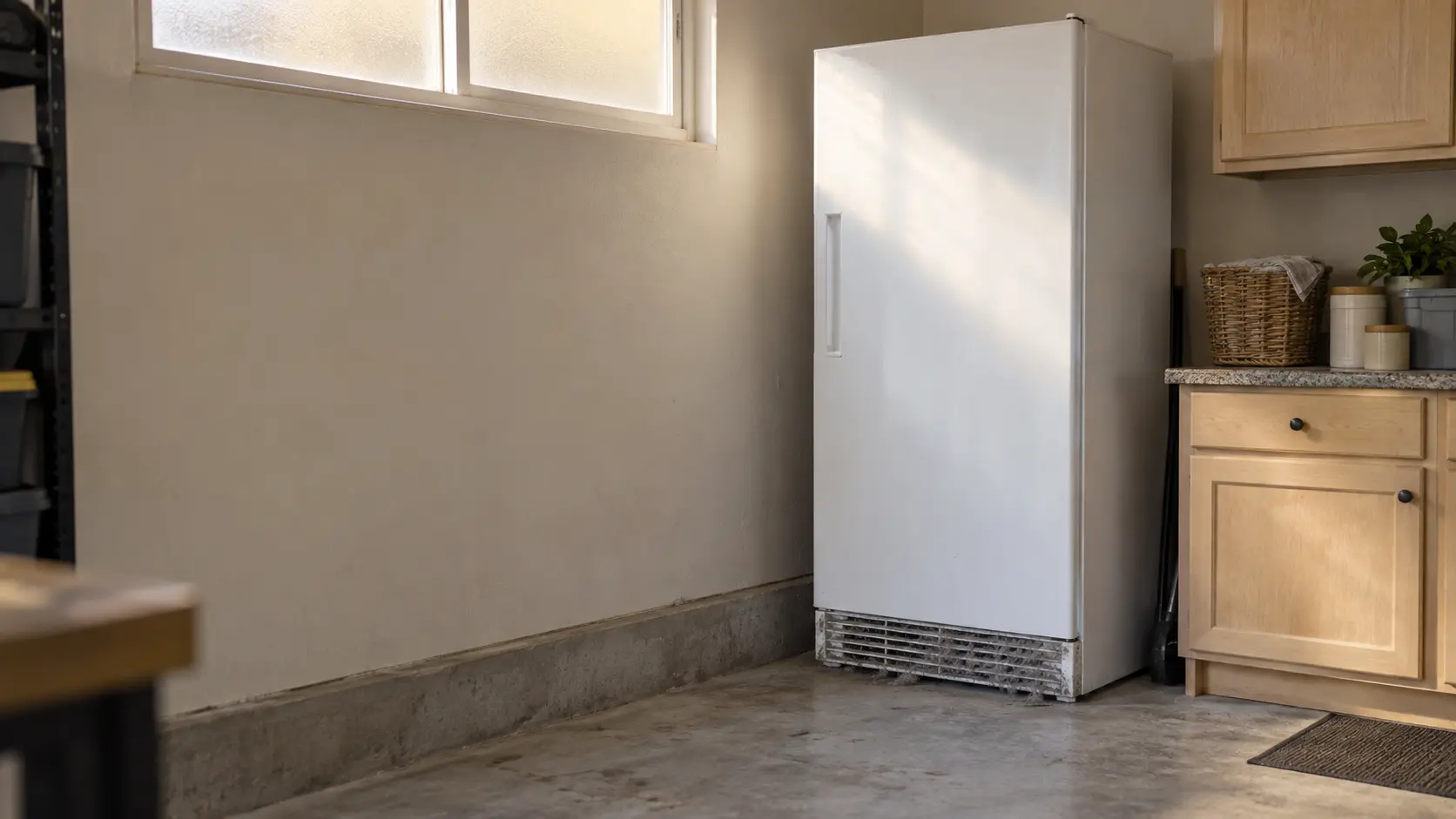
Everything a freezer removes from the food comes out of the cabinet as heat, through a condenser coil underneath, a coil on the back, or tubing buried in the outer walls. Frigidaire's chest manual warns that those walls can run warm as the compressor works. Box that heat in and the compressor runs longer, the cabinet walls sweat and the whole unit ages faster.
Clearances are also about access. A freezer shoved hard against a wall cannot be pulled out to clean the coil or check the drain, and its cord is often pinched behind it.
Warm outer walls are normal
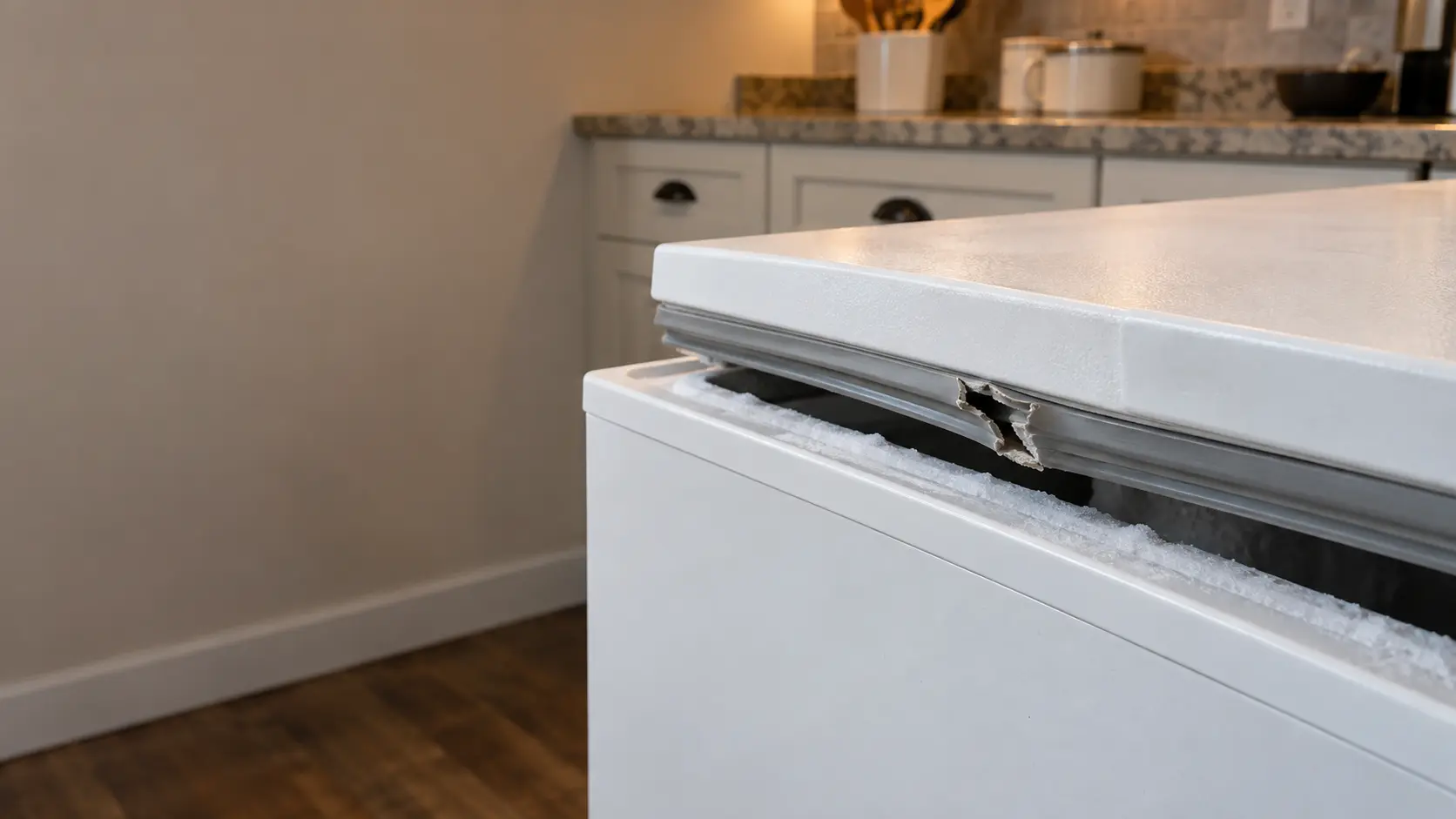
Many chest freezers and some uprights put their condenser tubing just inside the outer skin, so the sides feel warm to the hand. That is how the heat leaves. It is also why a chest pushed flush into a corner, with bins stacked against both sides, runs noticeably longer than the same chest standing free.
Source: Frigidaire — Chest Freezer User Manual (A31283301) — Clearances of 7.87 in. (200 mm) at the sides and back; exterior walls become warm as the compressor transfers heat; install on a level floor strong enough for a full load
The numbers, maker by maker
There is no single figure for freezer clearances. GE publishes one set for all of its current uprights and three for its chests by size, and a Frigidaire chest manual asks for far more room than either. The table shows how much they differ; the installation guide in the drawer of your own freezer overrides all of them.
| Freezer | Sides | Back | Top |
|---|---|---|---|
| GE upright, all current models | 3 in. | 2 in. | 3 in. |
| GE chest, 12 cu. ft. and larger | 2 in. | 2 in. | Lid must open fully |
| GE chest, 9–11 cu. ft. | 2 in. | 2 in. | Lid must open fully |
| GE chest, 5–7 cu. ft. | 3 in. | 3 in. | Lid must open fully |
| Frigidaire convertible chest (A31283301) | 7.87 in. (200 mm) | 7.87 in. (200 mm) | Lid must open fully |
Built-in columns and undercounter freezers
A built-in freezer column or an undercounter freezer drawer is designed to be enclosed by cabinetry, so the freestanding numbers above do not apply. Its installation guide sets the cutout size and the path the air takes, usually in and out through the front grille at the toe kick, and that grille must never be covered by a rug, a panel or a trash bin.
Source: GE Appliances — Upright & Chest Freezer: Installation and Location — Uprights: 3 in. sides, 2 in. back, 3 in. top; chests 9 cu. ft. and up: 2 in. sides and back; chests 5–7 cu. ft.: 3 in.; place solidly on the floor and shim an uneven floor; Frigidaire — Chest Freezer User Manual (A31283301) — Clearances of 7.87 in. (200 mm) at the sides and back; exterior walls become warm as the compressor transfers heat; install on a level floor strong enough for a full load

Getting the cabinet level and steady
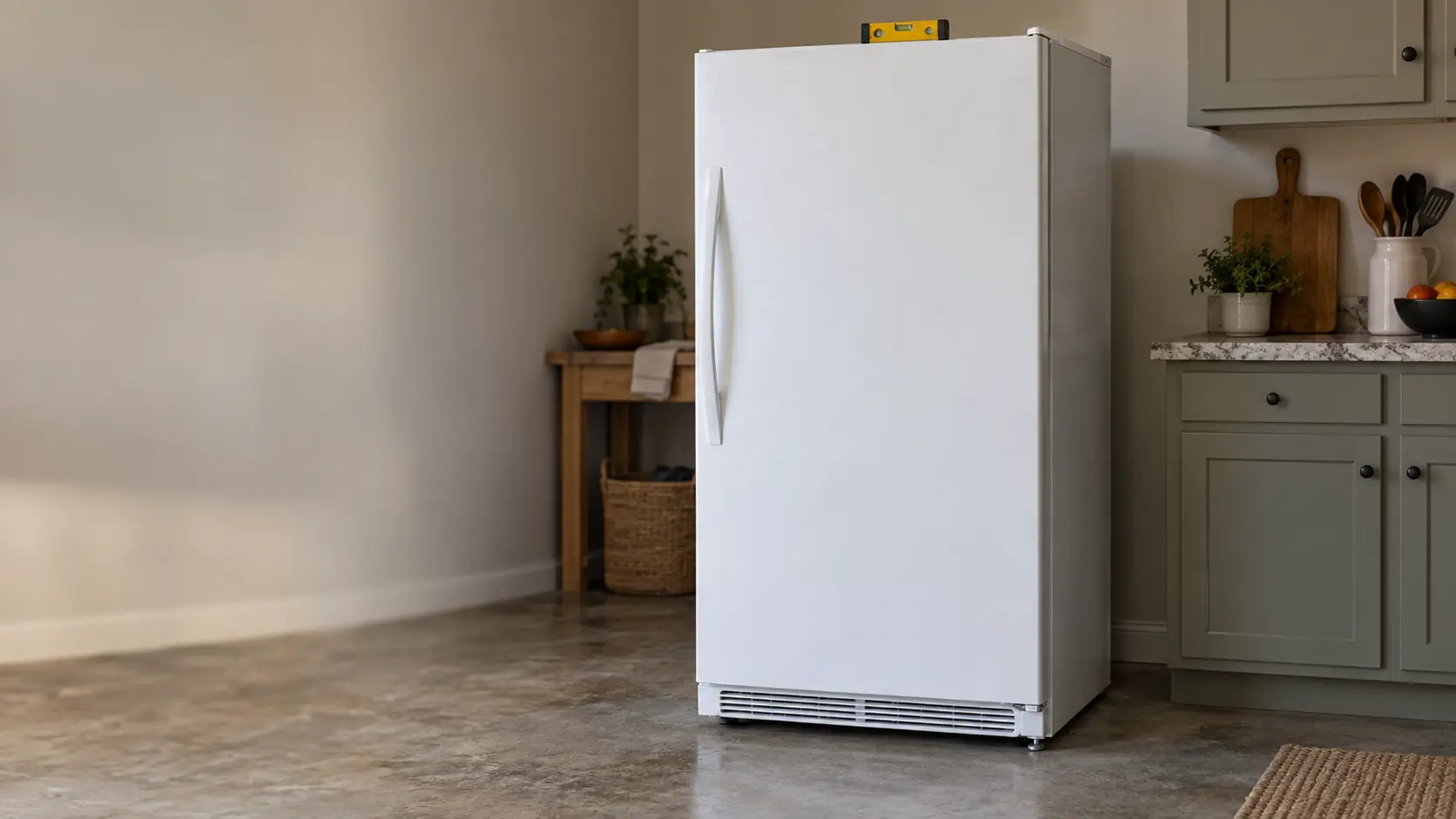
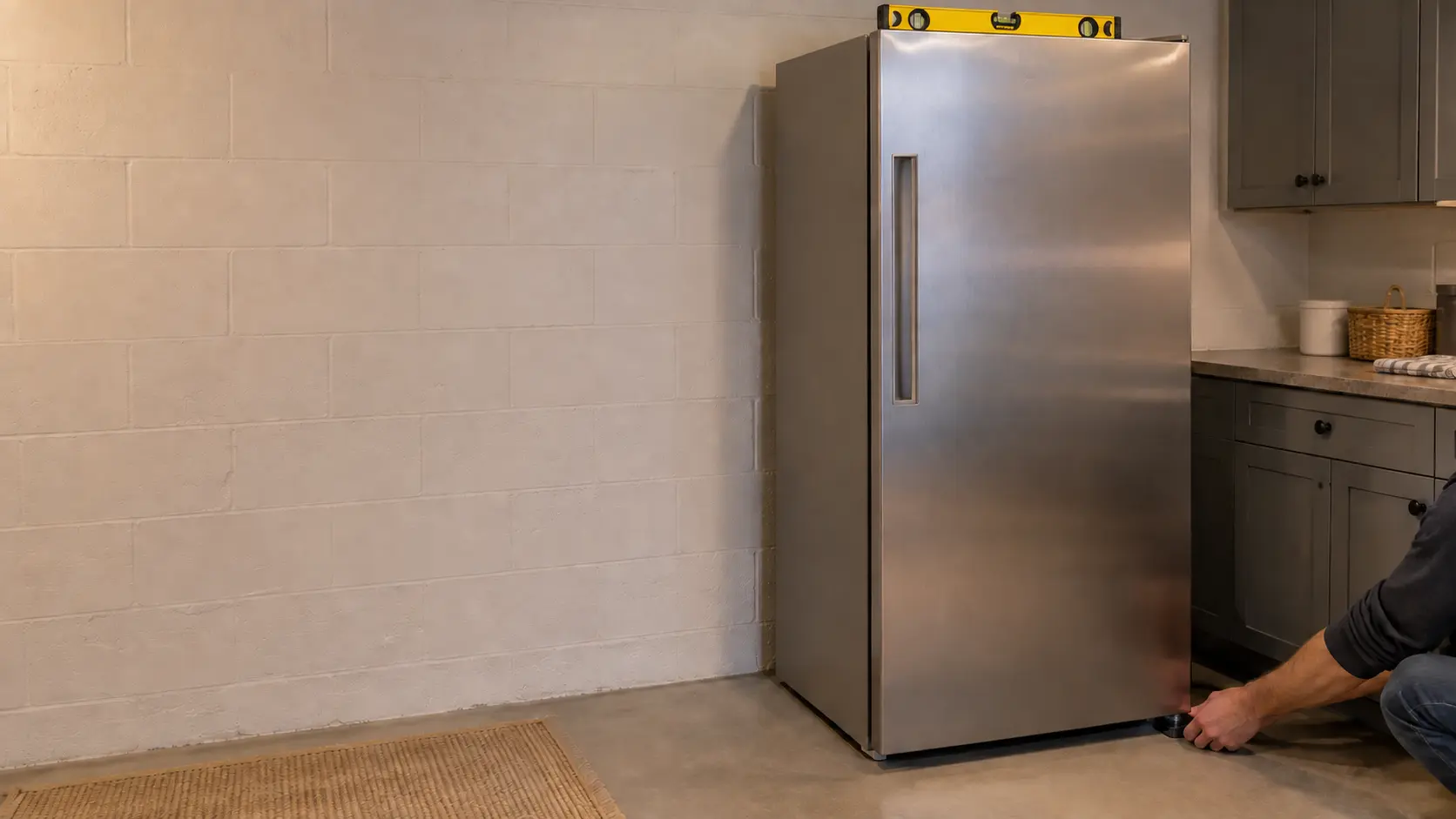
GE's instruction is to set the freezer solidly on the floor and use shims where the floor is uneven. Frigidaire's chest manual asks for a floor that is level and strong enough for a full load, with all bottom corners firm. A freezer that rocks when you lean on it is not level, whatever the bubble says.
Uprights usually have threaded leveling legs at the front and sometimes rollers at the back. Chests often sit on four feet or on casters. Put a spirit level on top of a chest in both directions, and on the top of an upright from side to side and front to back, then adjust until the bubble centers and the cabinet stops rocking.
- No rocking when pressed at each corner.
- Bubble centered side to side on the top.
- Upright door swings closed from half open.
- Chest lid meets its gasket evenly all the way around.
An upright door that closes itself
An upright with its front set a touch higher than its back lets the door swing shut under its own weight from a partly open position. If the door drifts open instead, it will sooner or later be left ajar overnight. Check whether your installation guide calls for this tilt, and never raise the front so far that the cabinet leans.
Source: GE Appliances — Upright & Chest Freezer: Installation and Location — Uprights: 3 in. sides, 2 in. back, 3 in. top; chests 9 cu. ft. and up: 2 in. sides and back; chests 5–7 cu. ft.: 3 in.; place solidly on the floor and shim an uneven floor; Frigidaire — Chest Freezer User Manual (A31283301) — Clearances of 7.87 in. (200 mm) at the sides and back; exterior walls become warm as the compressor transfers heat; install on a level floor strong enough for a full load
Door swing, lid room and the walkway
Frigidaire lists 58 inches of depth with the door opened to 90 degrees for one 20 cubic foot upright. In a narrow basement corridor or a garage with a car parked tight, that is the number that decides whether the door opens far enough to pull a shelf out. Many uprights, that one included, have reversible doors, so choose the hinge side before the freezer is loaded.
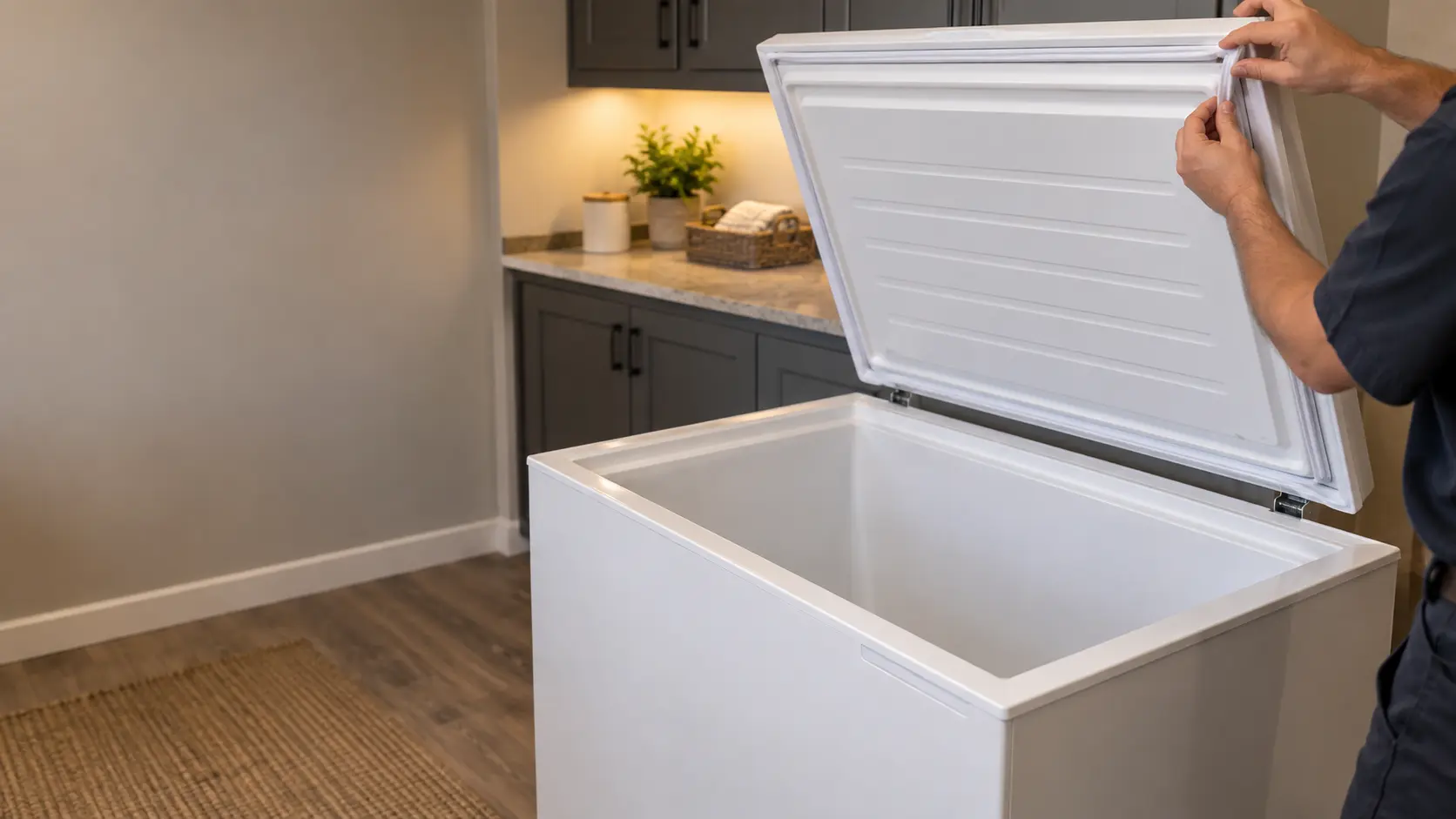
A chest needs headroom rather than depth. Shelves mounted above it, a low stair stringer or a garage-door track can stop the lid short of fully open, and a lid that cannot open all the way gets slammed and strains its hinges.
- Upright: the depth with the door at 90 degrees, plus room to pull a basket out.
- Upright: the hinge side chosen before loading, if the door is reversible.
- Chest: full lid travel with nothing mounted above it.
- Both: a path to the plug and the breaker that is not blocked by the open door.
Source: Frigidaire — 20 Cu. Ft. Garage Ready Upright Freezer spec sheet (FFUE2024A) — Depth with door open 90 degrees is 58 in.; reversible door; leveling legs